How to Clean Leather Furniture Properly: Every Leather Type, Step by Step

Leather furniture is expensive, and most of the damage done to it comes from cleaning it the wrong way — the kitchen spray, the soaking wet cloth, the olive oil someone swore by online. Cleaned properly, leather is one of the easiest surfaces in the house: dust it, wipe it, condition it a few times a year. The one thing you must do first is work out which type of leather you own, because the right method for one type can mark another permanently. This guide covers every common type.
The short answer
Vacuum with a soft brush, wipe with a dry microfiber cloth, then wipe again with a cloth that is barely damp. For a deeper clean, use a pH-balanced leather cleaner on the cloth — never sprayed straight onto the leather — working one full panel at a time, then buff dry. Condition every 3–6 months. Test every product on a hidden spot first, keep water to a minimum, and never use bleach, ammonia, all-purpose sprays or kitchen oils. If your leather is aniline or suede, read its section below before touching it.
Step 1: Work out your leather type
Check the care label first. If there is none, use the water-drop test: put one drop of water on a hidden area, such as the back or under a cushion, and watch it.
| Leather type | How it looks and feels | Water-drop test | Cleaning level |
|---|---|---|---|
| Protected (pigmented) | Even colour, smooth, slightly coated feel — the most common furniture leather | Drop beads and sits on the surface | Easiest — the full method below |
| Semi-aniline | Natural look with a light coating, soft feel | Drop soaks in slowly | Gentle version of the method below |
| Aniline | Very soft and natural, visible grain and markings, no coating | Drop darkens the leather and absorbs fast | Most delicate — specialist products only |
| Nubuck / suede | Velvety, fuzzy surface | Absorbs and marks at once | No liquids — dry methods only |
| Bonded leather | Leather fibres reconstituted on a backing; often on budget furniture | Usually beads | Gentle wipe only — it peels, and cleaning cannot fix peeling |
What you need
- A vacuum with a soft brush attachment
- Two or three soft microfiber cloths
- A pH-balanced leather cleaner made for your leather type
- A leather conditioner made for your leather type
- Plain water
- For suede and nubuck: a suede brush and eraser block instead of liquids
Step by step: protected and semi-aniline leather
Step 2: Vacuum the seams and crevices
Run the soft brush attachment over the whole piece — seats, back, arms, and down into the seams and under the cushions. Grit is leather's quiet enemy: rubbed into the surface every time someone sits down, it acts like fine sandpaper. Low suction, no pressing.
Step 3: Wipe with a dry cloth
Wipe the whole surface with a clean, dry microfiber cloth in long, even strokes. This lifts the dust the vacuum missed and shows you where the real dirt is — usually the arms, headrest and seat fronts, where skin oils build up.
Step 4: Wipe with a barely damp cloth
Dampen a cloth and wring it until almost no water comes out. The cloth should feel nearly dry. Wipe section by section, and dry each section with a second cloth before moving on. Leather should never be left wet — water that sits can leave a ring, especially on semi-aniline.
Step 5: Deep-clean with leather cleaner, one panel at a time
For ground-in dirt, put a small amount of leather cleaner on the cloth — not directly on the leather — and clean one complete panel at a time with gentle circular motions. Cleaning whole panels, rather than scrubbing one dirty spot, keeps the colour even. Wipe off any residue with a clean, slightly damp cloth; never let cleaner dry on the surface. Do this deep clean every 3–6 months, or when the damp-cloth wipe stops being enough.
Step 6: Condition every 3–6 months
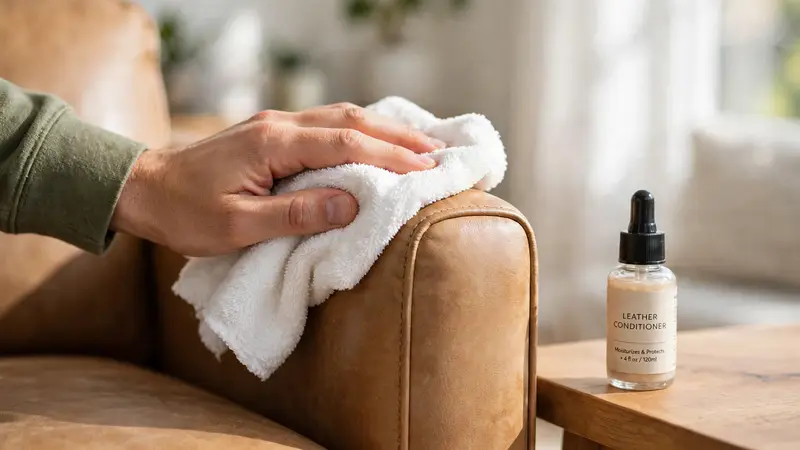
Conditioning replaces the moisture leather slowly loses to dry air, heat and sunlight, and it is what keeps the surface supple instead of cracking. Put a small amount of conditioner on a soft cloth and rub it in with long strokes. Let it absorb, then buff off every trace of excess with a dry cloth. Too much conditioner is worse than too little — the surplus sits sticky on the surface and attracts dust.
Aniline leather: the gentle rules
Aniline has no protective coating, so it absorbs whatever touches it — including water, which can leave a permanent ring. Dust and vacuum it exactly as above, but keep liquids to the bare minimum: a cloth that is only just damp, specialist aniline cleaner only, and no conditioning product unless it is made for aniline. Blot spills instantly (below), expect the leather to darken slightly with age and use, and keep it out of direct sunlight, which fades it faster than any other type. For a valuable aniline piece with a real stain, a professional leather cleaner is money well spent.
Suede and nubuck: no liquids at all
Water stains suede and nubuck, and creams or liquid conditioners mat the fibres flat and ruin the texture permanently. Clean them dry: brush with a suede brush to lift dirt and restore the nap, and rub marks gently with a suede eraser. That is the whole method — if a stain survives it, it is a job for a specialist product made for suede, tested in a hidden spot first.
Spills: blot, never rub
Most spill damage happens in the first minute. Take a clean, dry cloth and press it onto the spill; lift, turn to a clean part of the cloth, and press again. Repeat until no more liquid transfers. Never rub — rubbing pushes the liquid deeper and spreads the stain. For an oily spill on protected leather, blot the same way and let the spot rest; body and food oils often fade into protected leather over a few days. On aniline, blot and then leave it alone — adding water to chase the stain usually makes a bigger mark.
Mistakes that ruin leather furniture
- All-purpose and kitchen cleaners. Bleach, ammonia and general sprays strip the finish on protected leather and can wreck aniline on contact. Leather cleaner exists for a reason.
- Olive oil, coconut oil and baby oil. The internet's favourite shortcut. They darken leather unevenly, leave residue that can go rancid or feed mould, and make later proper conditioning harder.
- Too much water. A soaking cloth, or water left sitting, means rings, stiffness and dye movement. Barely damp, dried straight away.
- Spraying cleaner directly onto the leather. It lands unevenly and can spot. Cleaner goes on the cloth.
- Skipping the hidden-spot test. A product that is perfect on protected leather can darken aniline in seconds. Test, wait for it to dry, look, then proceed.
- Drying with heat or sun. Radiators, hairdryers and direct sunlight dry leather out and crack it. Room-temperature air drying only — and keep furniture out of strong sun day to day.
- Over-conditioning. More is not better. A sticky film that grabs dust is the sign you used too much.
More leather and home cleaning guides
For a sofa-specific deep-dive, see how to clean a leather couch. For footwear, how to clean leather shoes. And for the rest of the room: how to clean wood furniture properly and how to clean a mattress.
Useful products for this job
A matched cleaner and conditioner pair, made for furniture leather, covers both the cleaning and the conditioning steps. Prices change often, so check the current price on Amazon before you buy.
- Leather cleaner and conditioner kits on Amazon — look for a pH-balanced cleaner with a separate conditioner, and check the label matches your leather type before buying.
- Microfiber cloth packs on Amazon — soft, lint-free cloths for the dusting, wiping and buffing steps; keep a set aside for leather only.
A Natural Day is reader-supported. When you buy through links on this page, we may earn an Amazon commission at no extra cost to you.
Frequently asked questions
How often should you clean leather furniture?
Dust or wipe it weekly, damp-wipe every one to two weeks, deep-clean every 3–6 months, and condition every 3–6 months. Busy family furniture and pieces near sunny windows sit at the frequent end of those ranges.
How can you tell if leather is aniline or protected?
Use the water-drop test on a hidden spot. If the drop beads and sits on the surface, the leather is protected. If it darkens the surface and soaks in, it is aniline or semi-aniline — the faster it absorbs, the more delicate it is.
Can you clean leather furniture with vinegar?
It is not recommended. Vinegar is acidic, can dull or dry the finish, and may darken absorbent leathers. A pH-balanced leather cleaner costs little and is made for the material — use that instead.
What should you never put on leather furniture?
Bleach, ammonia, all-purpose sprays, abrasive pads, and kitchen oils such as olive or coconut oil. Also keep liquid products of any kind off suede and nubuck, and never soak any leather with water.
How do you get a water ring out of leather?
On protected leather, lightly dampen the whole panel evenly with a barely damp cloth and let it dry naturally — evening out the moisture usually fades the ring's edge. On aniline, rings often fade on their own over days; if one persists, it is a professional job.
Can you fix peeling bonded leather by cleaning it?
No. Peeling means the reconstituted surface layer is separating from its backing, and no cleaner or conditioner can reattach it. Clean bonded leather gently to slow further wear, and avoid picking at loose edges.
Sources
Leather types, the water-drop test, cleaning steps and conditioning intervals cross-checked against published leather furniture care guides (protected, semi-aniline, aniline, suede and bonded leather care; pH-balanced cleaners; 3–6 month conditioning). Written in our own words for A Natural Day readers.

Written by
MD DOLAR HOSEN
Technology expert and the founder and author of A Natural Day. He tests and reviews everyday tech, gadgets, and home essentials, and writes practical buying gui…


Comments (0)
Join the discussion — sign in to leave a comment.
Sign in to commentNo comments yet. Be the first to share your thoughts.