How to Clean a Fish Tank: The Safe Routine That Keeps Fish Healthy
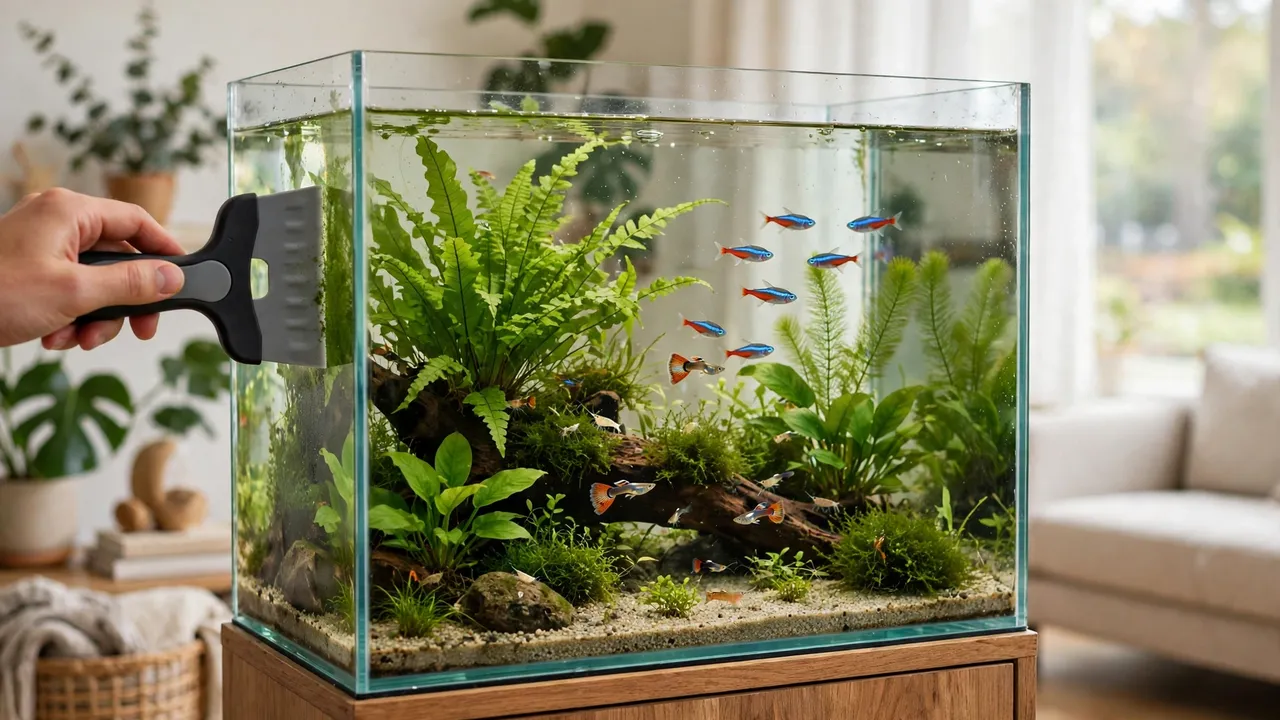
Cleaning a fish tank is not about making it spotless. It is about removing waste while protecting the invisible bacteria colony that keeps your fish alive. Those bacteria live in the filter media, the gravel and on the decorations — scrub everything sterile or change all the water at once, and the tank's balance crashes. The safe routine is gentler: clean the glass, vacuum the gravel, change part of the water, and leave the biology alone. Here it is, step by step.
The short answer
Leave the fish in the tank. Unplug the equipment, scrub the inside glass, vacuum the gravel while siphoning out 10–25% of the water, rinse filter media only in the removed tank water, then refill slowly with conditioned water matched to the tank's temperature. Never use soap, never drain the tank fully, and never rinse filter media under the tap. Done every 1–2 weeks, the whole routine takes about 30 minutes.
What you need
- A siphon gravel vacuum with a hose
- A bucket used only for the aquarium — never one that has held household cleaners
- An algae scraper or pad made for aquariums (plastic blade or soft pad for acrylic tanks)
- Water conditioner (dechlorinator) for tap water
- A thermometer
- An old towel for drips
- Optional: a liquid water test kit
How often to clean
| Task | How often | Notes |
|---|---|---|
| Scrape the glass | Weekly, or as needed | When algae starts to cloud your view |
| Vacuum gravel + water change | Every 1–2 weeks | 10% weekly, or 25% every two weeks |
| Rinse filter media | Every 2–4 weeks | Only in removed tank water, never tap water |
| Wipe the outside glass | As needed | Water or aquarium-safe cleaner, sprayed on the cloth — never into the tank |
Step by step
Step 1: Wash your hands — and rinse them well
Wash with soap, then rinse thoroughly. Traces of soap, lotion or perfume on your skin can harm fish, so the rinse matters as much as the wash. Keep a set of tools — bucket, siphon, scrubber — that are used for the tank only.
Step 2: Unplug the equipment
Switch off and unplug the heater, filter and lights before you start. A heater exposed to air as the water level drops can crack, and unplugging everything is basic safety around water and electricity. The fish stay in the tank — catching them causes stress they do not need.
Step 3: Scrub the inside glass first
Scrape algae off the inside walls before you touch the water level, so the loosened debris can be vacuumed out in the next step. On glass tanks, a scraper blade handles stubborn corners; on acrylic, use only a soft pad or plastic blade — acrylic scratches easily. Stop about an inch above the gravel so you do not drag grit across the surface.
Step 4: Clean the decorations in tank water
Lift out any decoration that is thick with algae and scrub it in a bucket of water you are about to siphon from the tank, using an algae pad or a brush kept for the aquarium. Hot tap water is fine for a stubborn piece. Soap is never fine — not on decorations, not on gravel, not on anything that goes back in the water.
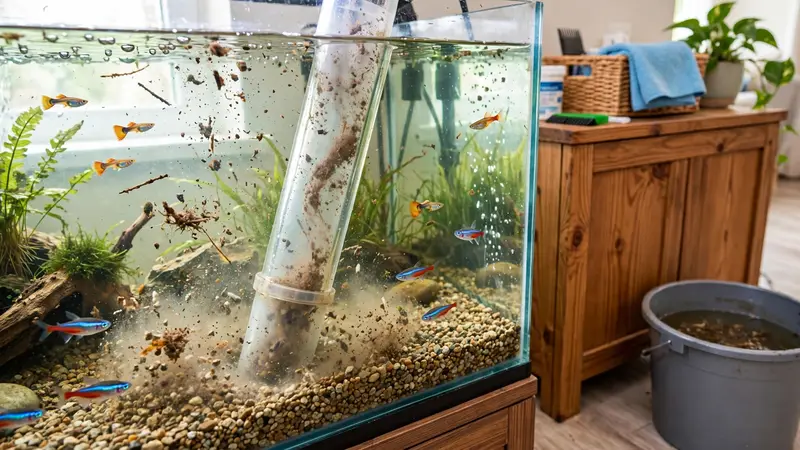
Step 5: Vacuum the gravel and siphon out 10–25%
Start the siphon into your bucket. Push the vacuum tube into the gravel, let the debris swirl up and out while the heavier gravel falls back, then lift to move to the next spot. Work across the whole bottom. Stop when you have removed 10–25% of the tank's water — that is your water change, done at the same time.
Step 6: Rinse the filter media in the siphoned water
Take the filter sponges or media and swish and squeeze them in the bucket of removed tank water until the worst of the muck is out. This is the step people get wrong: tap water's chlorine kills the beneficial bacteria living in the media, and soap would be worse. Replace media only when it is physically falling apart — it is a home for bacteria, not a disposable part.
Step 7: Refill slowly with matched, conditioned water
Fill your bucket with fresh tap water, check its temperature against the tank's and adjust until they match closely. Add water conditioner by the label directions to remove chlorine and chloramine. Then pour the water back in slowly — a sudden temperature or chemistry swing stresses fish more than a slightly dirty tank ever would.
Step 8: Restart everything and wipe the outside
Put the decorations back, restart the filter, heater and lights, and check the filter is flowing properly. Wipe the outside glass with a cloth dampened with water or an aquarium-safe cleaner. Wash your hands again, and you are done.
Why you never do a full teardown
A healthy tank runs on beneficial bacteria that convert toxic ammonia from fish waste into safer compounds. Those bacteria live on surfaces — filter media, gravel, decorations — not in the water itself. Draining the tank and scrubbing everything removes the colony, and the tank then has to cycle again while fish are living in it, which risks ammonia spikes that can kill them. Big water changes belong to emergencies only: chemical contamination, clearing medication, or a dangerous ammonia reading. For routine care, small and regular beats big and rare, every time.
Mistakes that harm fish
- Using soap or household cleaners. Even residue is toxic to fish. Anything that touches tank water stays soap-free, always.
- Changing all the water at once. The chemistry swing and bacteria loss can crash the tank. Never change more than half; 10–25% is the routine range.
- Rinsing filter media under the tap. Chlorine kills the bacteria the filter exists to grow. Tank water only.
- Removing the fish to a bowl. Capture and confinement are pure stress. Fish stay in the tank for routine cleaning.
- Sharing household buckets and sponges. Cleaning-product residue travels with them. Dedicated aquarium tools only.
- Skipping the conditioner. Untreated tap water carries chlorine and chloramine that burn fish gills. Every refill gets conditioned.
More home cleaning guides
More step-by-step cleaning from A Natural Day: how to clean a microwave, how to clean shower tiles, how to clean window tracks and how to clean floors naturally.
Useful products for this job
Two tools do almost all of this job. Prices change often, so check the current price on Amazon before you buy.
- Aquarium gravel vacuum siphons on Amazon — the one tool that vacuums the gravel and drains the water change at the same time; pick a size that suits your tank.
- Aquarium algae scrapers on Amazon — blade scrapers for glass tanks, soft pads for acrylic; a long handle keeps your hands drier.
A Natural Day is reader-supported. When you buy through links on this page, we may earn an Amazon commission at no extra cost to you.
Frequently asked questions
Do you remove fish when cleaning a tank?
No. For routine cleaning the fish stay in the tank — catching and moving them causes unnecessary stress. Unplug the equipment, work gently around them, and change only part of the water.
How much water should you change?
About 10% once a week, or 25% every two weeks, is the standard routine for an established tank. Never change more than 50% at once, and always condition the new water and match its temperature first.
Can you clean a fish tank with soap?
Never. Soap, detergent and household cleaners are toxic to fish, and residue clings to glass, gravel and decorations. Clean everything with plain water and aquarium-only tools.
Why is my tank dirty again so fast?
Usually overfeeding, too much light, or too many fish for the tank size. Feed only what the fish finish in a couple of minutes, keep lights to about 8 hours a day, and test the water — ammonia above 0.25 mg/L, any nitrite, or nitrate above 20 mg/L all call for a water change.
How do you clean algae off the glass?
Scrub the inside walls with an aquarium algae pad or scraper before your water change, so the siphon removes the loosened algae. Use a blade only on glass; acrylic tanks need soft pads or plastic blades to avoid scratches.
Should you clean the filter at the same time?
You can rinse the media during the same session — in the bucket of water you just siphoned out, never under the tap. Every 2–4 weeks is enough for most tanks, and only when the flow slows or the media is clogged with muck.
Sources
Steps, water-change percentages and safety rules cross-checked against published aquarium care guides from Petco, PetMD and established aquarium advice sites (partial changes of 10–25%, filter media rinsed in tank water, no soap, fish left in the tank). Written in our own words for A Natural Day readers.

Written by
MD DOLAR HOSEN
Technology expert and the founder and author of A Natural Day. He tests and reviews everyday tech, gadgets, and home essentials, and writes practical buying gui…


Comments (0)
Join the discussion — sign in to leave a comment.
Sign in to commentNo comments yet. Be the first to share your thoughts.