How to Clean a Stainless Steel Water Bottle (and Kill the Smell)
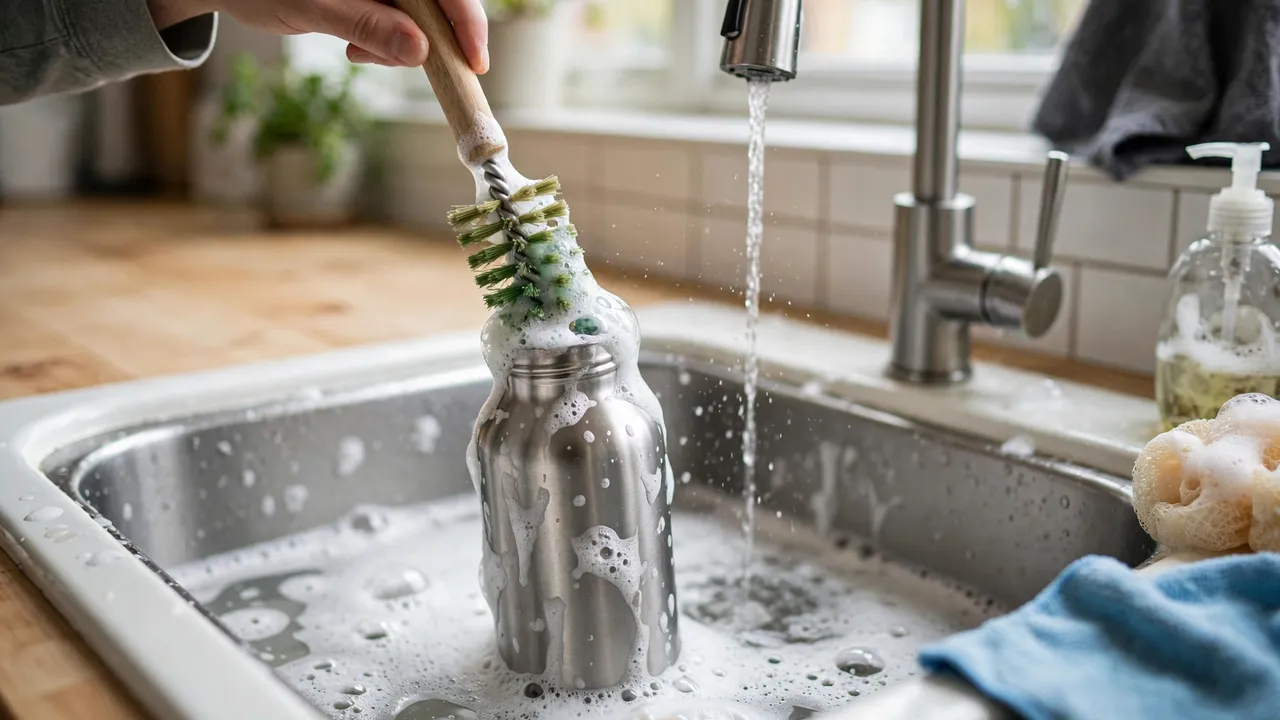
Stainless steel itself barely holds smells — it is non-porous and does not absorb flavours. So when a steel bottle smells musty, the smell is almost never the steel. It is the biofilm inside the bottle and, above all, the lid: the silicone gasket, the threads and the straw are where moisture, drink residue and mould collect. Clean all of it — bottle, lid and gasket, taken apart — dry it with the lid off, and the smell problem disappears. Here is the full routine: the daily wash, the weekly deep clean, and the fixes for a bottle that already smells.
What you need
- Long-handled bottle brush (soft bristles)
- Small brush or old toothbrush for the lid and threads
- Mild dish soap
- Baking soda
- White vinegar (for deep cleans and limescale)
- A drying rack
The daily wash (after every use)
Step 1: Empty and rinse straight away
Tip out whatever is left and rinse the bottle with warm water as soon as you can. Residue from coffee, juice, sports drinks and smoothies feeds bacteria fast; plain water residue is far more forgiving, but the rinse habit costs ten seconds.
Step 2: Wash with warm soapy water and the bottle brush
A few drops of dish soap, warm water, and a proper scrub with the bottle brush — especially the bottom and the shoulder where the walls angle in, the two places residue collects. A rinse alone does not remove biofilm; the brush does.
Step 3: Wash the lid separately, every time
Unscrew the lid and wash it inside and out with soapy water, running the small brush around the threads and the drinking spout. The lid is where most of the bacteria in a "dirty bottle" actually live.
Step 4: Air-dry upside down, lid off
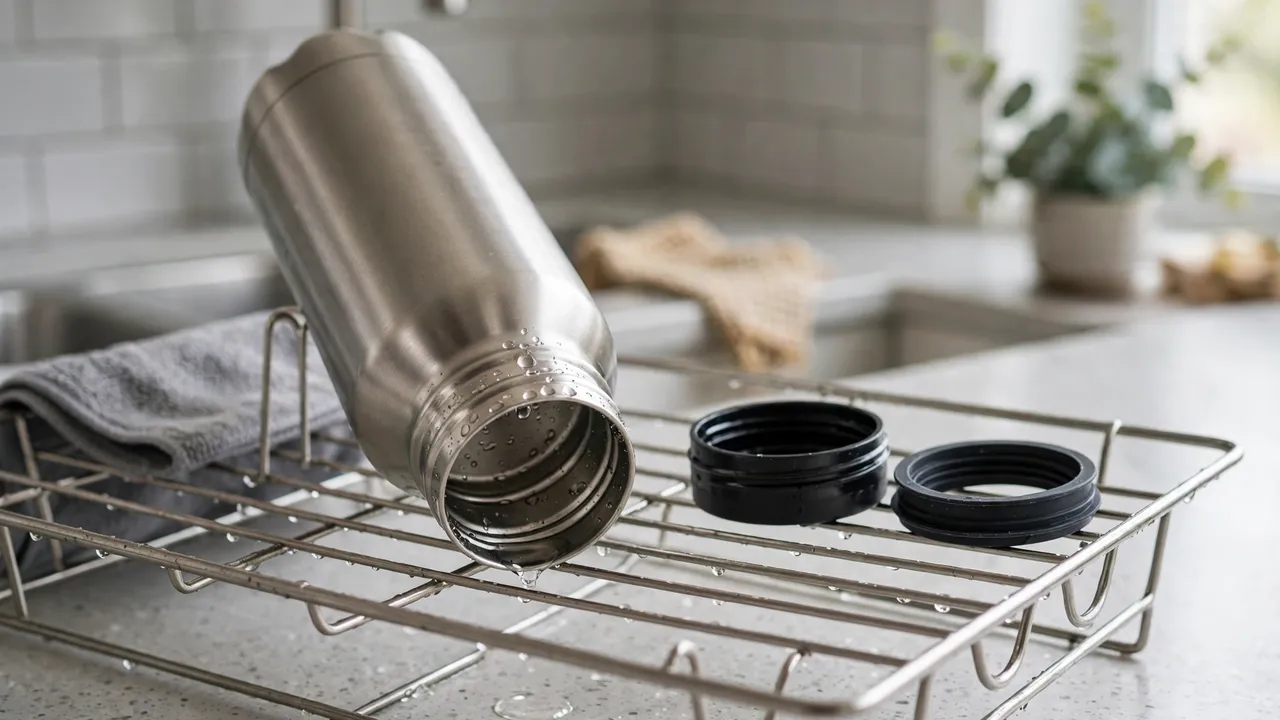
Stand the bottle upside down on a rack with the lid off and the parts separate. This step matters more than any product: sealing a damp bottle traps moisture, and trapped moisture is the primary cause of mould and musty smells. Never screw the lid onto a wet bottle.
The weekly deep clean (kills smells and biofilm)
Step 1: Take everything apart
Remove the lid, pull out the silicone gasket if it comes out, and separate any straw parts. These hidden pieces are the usual source when a washed bottle still smells — check under the gasket first; a dark or pink film there is mould or yeast, and it is very common.
Step 2: Soak in baking soda solution
Fill the bottle with warm water and a tablespoon of baking soda; put the lid parts in a bowl of the same mix. Leave 30–60 minutes — overnight for a bottle that already smells. Baking soda neutralises odours and loosens biofilm without any risk to the steel.
Step 3: Scrub everything
Bottle brush inside the bottle, toothbrush on the gasket, threads, spout and straw. Work the gasket's groove — that is the mould's favourite home.
Step 4: Rinse hot and dry completely
Rinse every piece until no baking soda remains, then air-dry everything fully, apart, before reassembling — give it several hours. Reassembling damp restarts the whole problem.
Stubborn smells, stains and limescale
| Problem | Fix |
|---|---|
| Musty smell that survives washing | It is the gasket or lid, not the bottle. Deep-clean the parts separately; if the gasket still smells after soaking and scrubbing, replace it — gaskets are cheap and wear out. |
| Coffee and tea stains | Baking soda paste on the brush, or a baking soda soak. A denture-cleaning tablet dissolved in warm water also works well. |
| White limescale film (hard water) | Fill with equal parts white vinegar and water, soak 30–60 minutes, brush, rinse. Vinegar dissolves mineral deposits that soap cannot. |
| Mould spots | The vinegar soak plus a thorough toothbrush scrub of every crevice, then complete drying. Repeat if needed. |
| Metallic taste | Usually new-bottle residue or cleaner not fully rinsed. Wash, rinse very thoroughly, and run one baking soda soak. |
What never to do
- Never use chlorine bleach on stainless steel. Chlorine corrodes and pits stainless steel and can damage the finish permanently. (You will see bleach suggested for plastic bottles — steel is different.)
- Never mix vinegar and bleach — the combination produces toxic chlorine gas. Use one cleaner at a time, ever.
- Do not seal the bottle wet, and do not store it with the lid on between uses if you can avoid it.
- Do not skip the brush. Swishing soapy water around does not remove biofilm.
- Dishwasher caution: many insulated bottles are hand-wash only — dishwasher heat can damage the vacuum seal and the exterior finish, and lids and gaskets warp. Check your maker's guidance; when in doubt, hand-wash.
- No boiling water in vacuum-insulated bottles unless the maker allows it — and never leave sugary drinks sitting in the bottle for days.
Habits that keep a bottle fresh
- Rinse after every use; wash daily if the bottle held anything but water.
- Store it with the lid off so the inside stays dry and aired.
- Deep-clean weekly — or after any smoothie, milk or protein drink, which spoil fastest.
- Inspect the gasket monthly and replace it when it stays smelly, cracks or loses its seal.
- Empty it at night. Water left sitting for days grows the very biofilm you are trying to avoid.
More stainless steel care
Steel around the kitchen all follows the same gentle logic — see how to polish stainless steel for sinks and appliances, and how to clean stainless appliances.
Frequently asked questions
How do I get the smell out of a stainless steel water bottle?
Take the lid fully apart, including the gasket, and soak bottle and parts in warm water with a tablespoon of baking soda for 30–60 minutes (overnight if the smell is strong). Scrub with a bottle brush and a toothbrush, rinse, and air-dry completely with the lid off. The smell almost always lives in the gasket and lid, not the steel.
Can I put a stainless steel water bottle in the dishwasher?
Check the maker first. Many insulated bottles are hand-wash only because dishwasher heat can damage the vacuum insulation and the outer finish, and plastic lids and silicone gaskets can warp. Uninsulated bottles are often dishwasher-safe. Hand-washing takes two minutes and is always safe.
Is vinegar safe for cleaning a stainless steel bottle?
Yes. A soak in equal parts vinegar and water for 30–60 minutes removes limescale and helps with odours, and it does not harm stainless steel. Rinse thoroughly afterwards. Never combine vinegar with bleach.
Why does my bottle smell even after washing?
Because the parts that smell were not cleaned or not dried: the gasket, the lid threads and the straw trap moisture and residue, and sealing the bottle while damp grows mould in exactly those places. Disassemble, deep-clean the parts, and always dry with the lid off.
How often should I wash my water bottle?
Rinse after every use, wash with soap and a brush daily if it held anything besides water (and every day or two for water-only use), and do the baking soda deep clean weekly. Bottles used for smoothies, milk or protein shakes need washing the same day, every time.
Can I use bleach to disinfect a stainless steel bottle?
No. Chlorine bleach corrodes stainless steel, causing pitting and discolouration. Baking soda soaks, vinegar soaks and thorough hot soapy scrubbing disinfect a steel bottle effectively without damaging it.
Sources
Method cross-checked against bottle manufacturers' care guidance (Thermos and others: daily soapy wash with a bottle brush, weekly baking soda deep clean, disassemble and clean gaskets, air-dry with the lid off, no chlorine bleach on stainless steel). Written in our own words for A Natural Day readers.

Written by
MD DOLAR HOSEN
Technology expert and the founder and author of A Natural Day. He tests and reviews everyday tech, gadgets, and home essentials, and writes practical buying gui…
Comments (0)
Join the discussion — sign in to leave a comment.
Sign in to commentNo comments yet. Be the first to share your thoughts.