How to Clean a Shower Head With Vinegar: The Bag Method (No Tools)
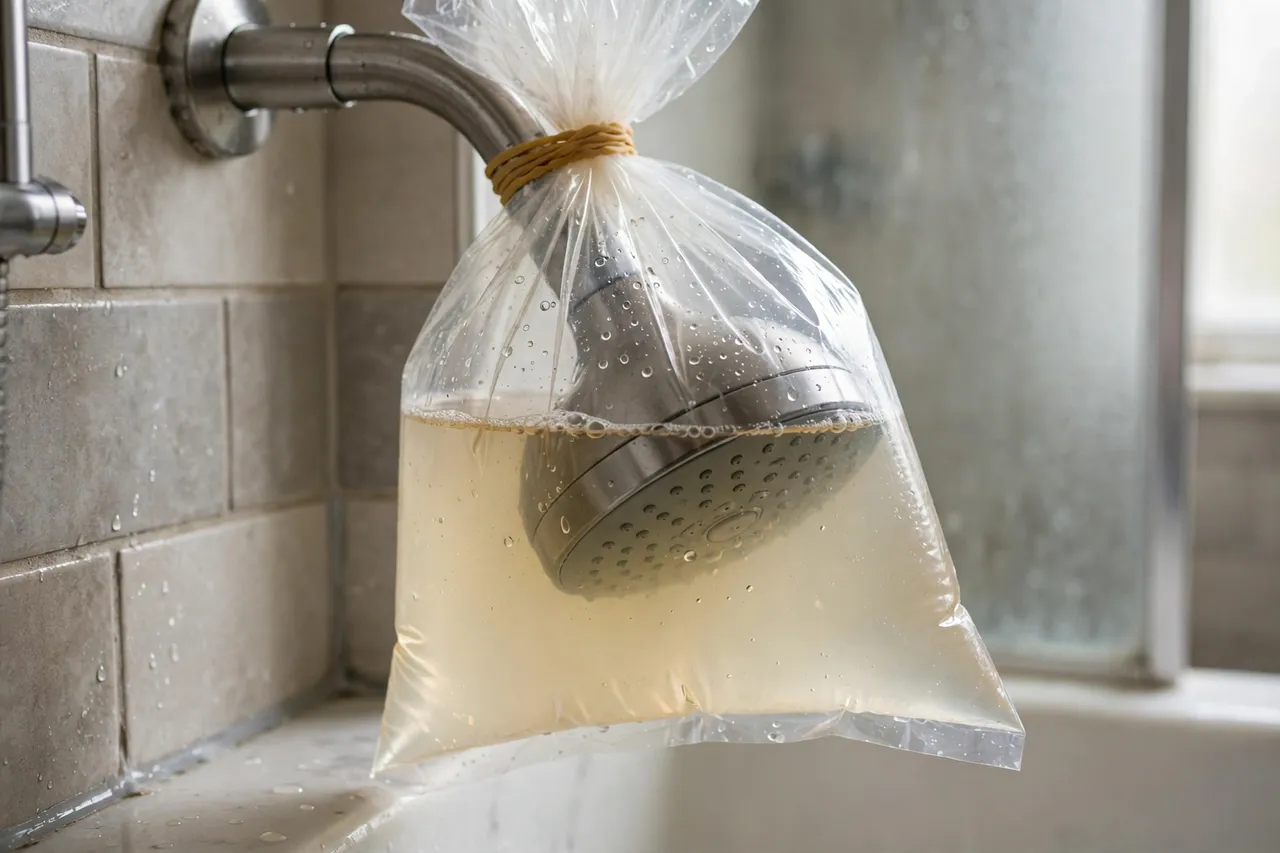
A shower that sprays sideways, sputters, or has lost its pressure is usually not broken — it is clogged. Every shower leaves a little dissolved mineral behind in the nozzles, and over months it hardens into limescale that blocks the holes one by one. White vinegar dissolves that scale, and the classic bag method does it without removing the shower head or using any tools: fill a bag, tie it on, wait, scrub, flush. Ten minutes of work, and the pressure comes back.
What you need
- White distilled vinegar (the standard 5% kind)
- A sturdy plastic bag (a quart-size freezer bag suits most heads)
- A rubber band, zip tie or twist tie
- An old toothbrush
- A toothpick or pin (for stubborn nozzles)
- A cloth
Before you start: check the finish
Vinegar is a mild acid, and soak time depends on the finish. Chrome and stainless steel can soak as long as the scale needs — hours or overnight. Special finishes are thinner-skinned: matte black, brushed gold, brass, nickel and oil-rubbed bronze can dull or spot in a long acid bath, so keep those to 30–60 minutes, rinse well, and do a short soak first if you are unsure. Plastic heads are fine with vinegar; warm (not boiling) vinegar works faster on heavy scale.
The bag method, step by step
Step 1: Fill the bag with vinegar
Pour enough vinegar into the bag to submerge the face of the shower head once it is pulled up — roughly half-full for most bags. Adding baking soda is optional; it fizzes and helps lift surface grime, but the vinegar's acid is what dissolves the scale, and the two partly neutralise each other, so plain vinegar is the reliable choice.
Step 2: Tie the bag over the shower head
Lift the bag up over the head so every nozzle is under the vinegar, gather the top of the bag around the neck or pipe, and secure it firmly with the rubber band or tie. Check that the head stays submerged and the bag is not going to slip off mid-soak.
Step 3: Soak — 1 hour to overnight
For a routine descale, 1–2 hours is enough. For a head that has slowed to a trickle, leave it 4–8 hours or overnight. You may see tiny bubbles on the scale — that is the acid working. (Special finishes: stick to the shorter times above.)
Step 4: Remove the bag and scrub the nozzles
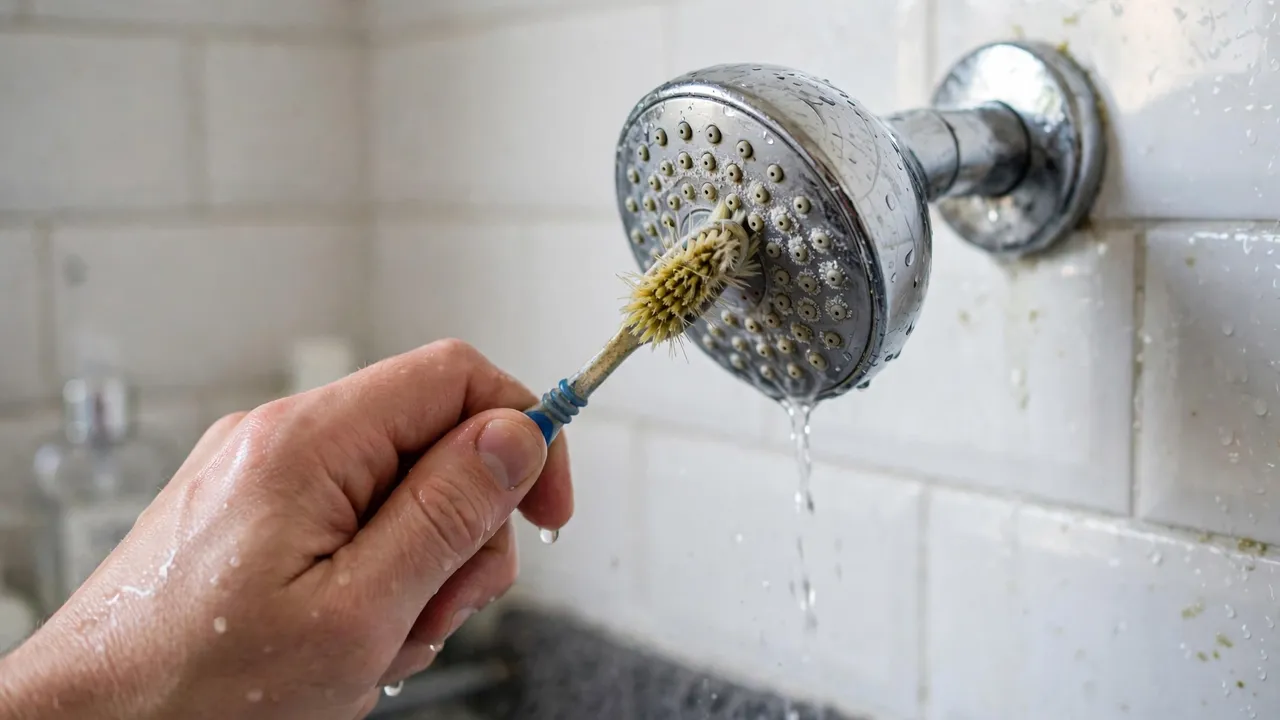
Take the bag off and pour the vinegar away. Scrub the face with the old toothbrush. Most modern heads have soft rubber nozzles — rub them with your thumb to flex them, which pops the loosened scale out. Clear any still-blocked nozzle with a toothpick.
Step 5: Flush with hot water
Run the shower on hot at full pressure for a minute or two to push out the loosened scale and rinse away the vinegar. Check the spray pattern: every jet should point straight. If a couple are still off, scrub those nozzles once more while the water runs.
The bowl method (if the head unscrews)
If the head unscrews by hand — or with a wrench over a cloth to protect the finish — a bowl soak cleans more: submerge the head face-down in vinegar for the same times as above. The bonus is the inlet side: rinse the small mesh filter screen where the head meets the pipe, since grit there also weakens the spray. Mind the small rubber washer inside the connection when you take it apart, and put it back before reattaching. Handheld heads are easiest of all — just rest the head in a bowl of vinegar with the hose over the side.
Why shower heads clog (and why it matters)
Tap water carries dissolved calcium and magnesium. Each time the shower dries, a trace stays behind in the nozzles; months of traces become the white-grey crust called limescale. Beyond weak pressure, a scaled, damp shower head can shelter biofilm — a slimy layer where bacteria live — which is the other good reason to descale regularly rather than once in a crisis. Descaling every 1–3 months (more often with very hard water) keeps both the pressure and the hygiene where they should be.
If vinegar is not enough
- Repeat the soak: years of scale may need a second overnight round.
- Warm the vinegar before soaking — heat speeds the acid up.
- A commercial calcium/lime remover is the backup for crust vinegar cannot shift — follow its label, check it suits your finish, and rinse very well afterwards.
- Still weak after descaling? The problem may be elsewhere — a clogged inlet filter, a kinked hose on a handheld, or low household pressure. The filter rinse in the bowl method is the next check.
More bathroom cleaning guides
The shower head is one part of the same job: how to clean shower tiles and how to clean shower mold finish the set.
Frequently asked questions
How do you clean a shower head with vinegar without removing it?
Fill a sturdy plastic bag with white vinegar, pull it up over the shower head so the nozzles are fully submerged, and tie it in place with a rubber band or zip tie. Leave it for 1–2 hours for a routine clean or overnight for a badly clogged head, then remove the bag, scrub the nozzles with an old toothbrush, and run the shower hot for a minute to flush.
How long should you soak a shower head in vinegar?
About 30 minutes to 2 hours for routine limescale, and 4–8 hours or overnight when the flow has slowed badly. Chrome and stainless steel tolerate the long soaks; special finishes — matte black, brushed gold, brass, oil-rubbed bronze — should stay at 30–60 minutes so the acid does not dull them.
Why is my shower head spraying in different directions?
Limescale. Mineral deposits build up unevenly in the nozzles, partly blocking some holes so the jets deflect sideways and the overall pressure drops. A vinegar soak dissolves the scale and straightens the spray — it is a cleaning problem, not a broken shower head, in most cases.
Can vinegar damage a shower head?
On chrome, stainless steel and plastic, no — vinegar is the standard, safe descaler. On thin special finishes (matte black, gold tones, oil-rubbed bronze), a long soak can dull or spot the coating, so keep those soaks short and rinse well. Never use boiling vinegar, especially on plastic.
How often should you clean a shower head?
Every 1–3 months in most homes, and monthly if your water is very hard or you see the spray pattern start to wander. Regular short soaks prevent the heavy build-up that needs overnight treatment, and they stop biofilm settling in the nozzles.
What if my shower is still weak after cleaning the head?
Check the inlet filter screen where the head connects to the pipe — grit there chokes the flow before the water reaches the nozzles. Unscrew the head, rinse the mesh, and reattach. If the whole house has weak pressure, or only this shower does even with a clean head and filter, the cause is plumbing, not scale.
Sources
Method cross-checked against plumbing and home-care guidance (vinegar bag soak times, finish cautions for matte black, gold and bronze, rubber-nozzle flexing, inlet filter rinse, 1–3 month descale rhythm). Written in our own words for A Natural Day readers.

Written by
MD DOLAR HOSEN
Technology expert and the founder and author of A Natural Day. He tests and reviews everyday tech, gadgets, and home essentials, and writes practical buying gui…

Comments (0)
Join the discussion — sign in to leave a comment.
Sign in to commentNo comments yet. Be the first to share your thoughts.