How to Clean a Toaster Oven: Crumbs, Grease and the Glass Door
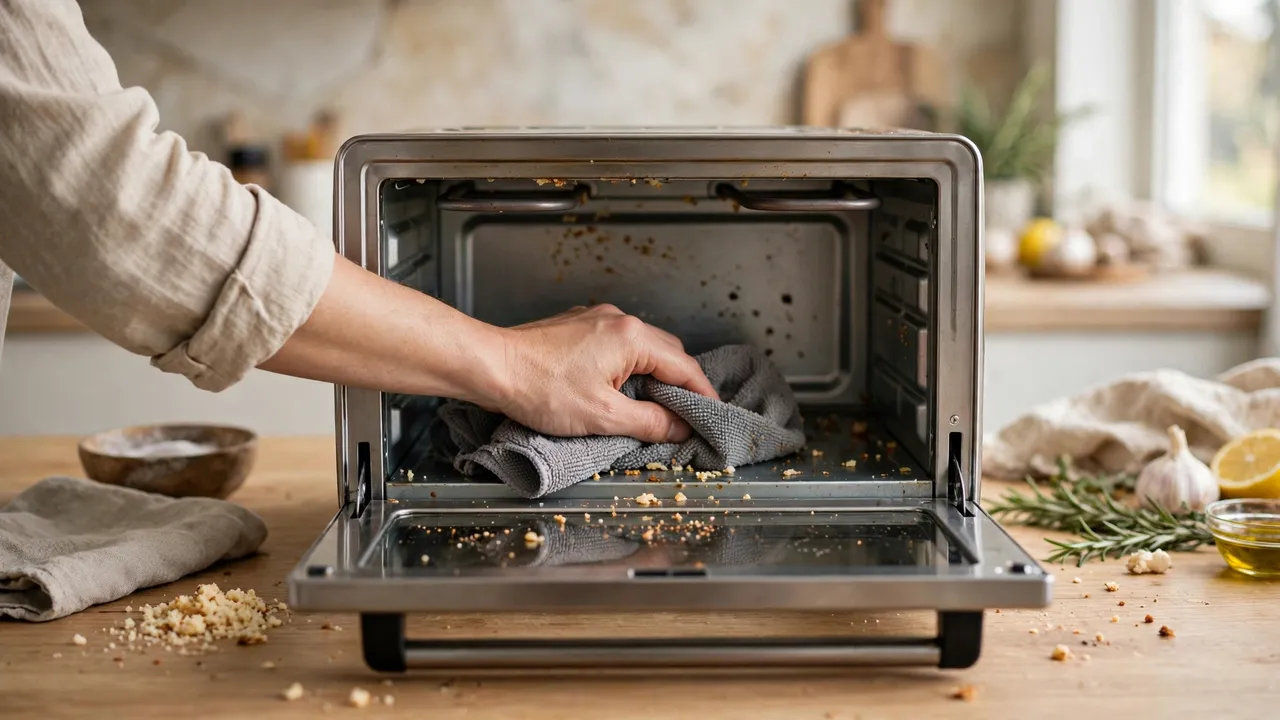
A toaster oven has the least room to hide dirt of any appliance: the cavity is small, the elements sit inches from the food, and every roast or cheese melt sprays grease onto walls that are right there. The good news is that it cleans with kitchen basics — dish soap water for the routine clean, a baking soda paste for baked-on grease, and about 20–45 minutes. No oven cleaner, no steel wool, and one part you never scrub at all: the heating elements.
What you need
- Dish soap and warm water
- Baking soda (for the paste)
- A non-abrasive sponge and a soft brush
- A cloth or microfiber cloth, plus paper towels
- White vinegar (for the glass, optional)
- A melamine sponge (optional, for light browning on glass)
The rules before you start
- Unplug it and let it cool completely. Every step assumes a cold, unplugged oven.
- Never scrub the heating elements. The rods or coils at the top and bottom get no paste, no soaking, no scouring — at most, a gentle wipe with a barely damp cloth if something lands on them.
- No steel wool, scouring powders or caustic oven cleaner. They scratch glass and metal, strip paint on coloured models, and attack non-stick coatings and elements. Baking soda does the same job gently.
- Damp, not wet, inside. Wring the cloth well; water should never pool in the cavity or run into vents and controls.
The deep clean, step by step
Step 1: Empty the crumb tray
Slide out the crumb tray and tip the crumbs into the bin. If the oven is light enough, hold it over the bin with the door open and shake or brush the loose crumbs out of the cavity and door seals too. Crumbs are not just a mess — a packed crumb tray is a genuine fire risk, which is why this step comes first and often.
Step 2: Soak the removable parts
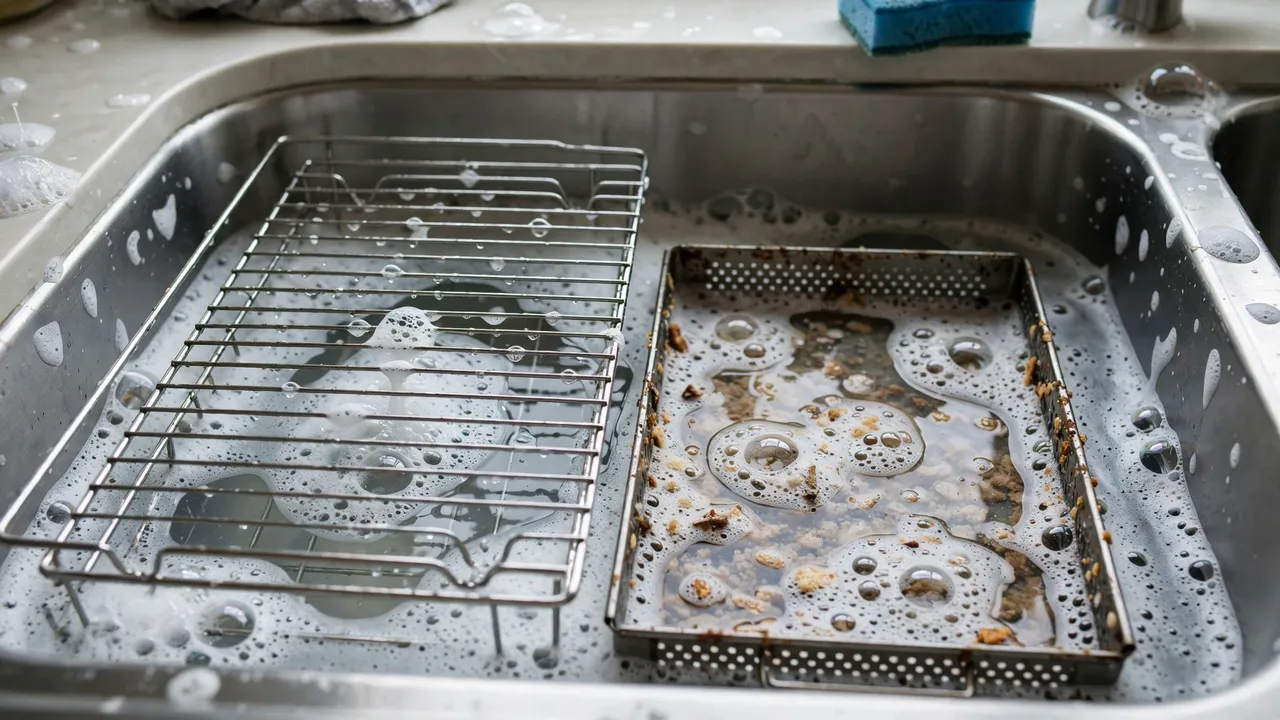
Take out the wire rack, baking tray and crumb tray and soak them in hot water with dish soap for 20–40 minutes (up to an hour, or even overnight in bad cases). Then scrub with the non-scratch sponge or brush — corners of the tray and where the rack wires cross hold the most grime. Dry everything fully before it goes back. Check the manual before putting any part in a dishwasher.
Step 3: Wipe the interior
Dip the sponge or cloth in warm water with a few drops of dish soap (a little vinegar in the water helps on grease), wring it out well, and wipe the walls, floor and ceiling of the cavity. Work around the elements, not over them. Rinse the cloth often — a dirty cloth just moves the grease around.
Step 4: Baking soda paste on baked-on spots
Mix about 3 tablespoons of baking soda with 1 tablespoon of water into a thick paste. Spread it over baked-on grease on the walls and floor — avoiding the elements completely — and leave it 15–20 minutes (up to an hour for stubborn carbon). The paste softens and lifts the layer as it sits; you will see it darken. Scrub gently with the sponge, then wipe away all residue with a clean damp cloth. Repeat on anything that survives rather than scrubbing harder.
Step 5: The glass door
The door shows grime most, and the same paste works best on it: a thin layer on the inside of the glass, 15–20 minutes, wipe away with a damp cloth. For light browning, a melamine sponge is remarkably effective on glass. Finish with a mist of plain water or a 50/50 vinegar-and-water wipe and a dry microfiber cloth for a streak-free result. Wipe the outside, handle and knobs with the soapy cloth.
Step 6: Dry, reassemble, done
Make sure the cavity and all parts are fully dry before putting the rack and trays back and plugging in. A quick test run on toast setting for a minute confirms everything is dry and working.
The 5-minute speed clean
For a light week: unplug, empty and wipe the crumb tray, soak nothing — just wipe the interior and glass with the soapy cloth, dry, done. Done weekly, this is what stops the deep clean from ever being a big job.
How often to clean each part
| Part | How often |
|---|---|
| Crumb tray | Weekly, or whenever crumbs are visible |
| Rack and baking tray | Wipe after greasy cooks; soak monthly |
| Interior walls | Monthly, or when spatter builds up |
| Glass door | Monthly, or when you cannot see through it clearly |
| Full deep clean | Every 2–3 months in regular use |
Keep it clean longer
- Empty the crumb tray before it packs down — it is a 20-second job that prevents the smoke and the fire risk.
- Wipe fresh spatter while the oven is still slightly warm (unplugged) — it comes off in seconds instead of baking on.
- Use the baking tray under greasy food so drips land on the washable part, not the oven floor.
- About foil: several manufacturers advise against lining the drip pan or floor with foil — it can reflect heat, cause overheating and touch the elements. Follow your manual, not the habit.
More small-appliance cleaning guides
Same paste, same patience: how to clean a microwave and how to clean a waffle maker.
Frequently asked questions
How do you clean baked-on grease in a toaster oven?
With a baking soda paste: about 3 tablespoons of baking soda to 1 tablespoon of water, spread over the greasy areas (never the heating elements), left for 15–20 minutes or up to an hour, then gently scrubbed and wiped away with a damp cloth. The paste softens carbonised grease so it wipes off instead of needing force.
Can you use oven cleaner in a toaster oven?
No. Caustic oven cleaners attack the interior coatings and the heating elements, and the fumes have no place in a small appliance used for food. Dish soap water handles routine dirt and baking soda paste handles baked-on grease — that pair covers everything a toaster oven collects.
How do you clean the heating elements of a toaster oven?
Mostly, you do not. Elements should never be scrubbed, soaked or pasted. If food lands on one, let the oven cool fully and wipe the spot gently with a barely damp cloth. Burn-off handles the rest in normal use — running the oven normally burns residue off the elements themselves.
How do you get the glass door clean?
Spread a thin layer of baking soda paste on the inside of the glass, wait 15–20 minutes, and wipe with a damp cloth; a melamine sponge lifts light browning. Finish with a water or vinegar-water wipe and a dry microfiber cloth so it dries streak-free.
How often should you clean a toaster oven?
Empty the crumb tray weekly, wipe the interior and glass monthly, and do the full deep clean every 2–3 months with regular use. The real rule is simpler: clean it when it starts looking dirty — waiting lets spatter bake into carbon that takes the long paste treatment.
Can the rack and trays go in the dishwasher?
Some can and some cannot — it depends on the model and the tray's coating. Check the manual first. Hand-washing after a hot soapy soak takes only a few minutes and is safe for every model, which is why it is the default method here.
Sources
Method cross-checked against appliance-care guidance (crumb tray first, 20–40 minute soaks, baking soda paste dwell times, elements never scrubbed, no caustic oven cleaner or steel wool, foil cautions). Written in our own words for A Natural Day readers.

Written by
MD DOLAR HOSEN
Technology expert and the founder and author of A Natural Day. He tests and reviews everyday tech, gadgets, and home essentials, and writes practical buying gui…



Comments (0)
Join the discussion — sign in to leave a comment.
Sign in to commentNo comments yet. Be the first to share your thoughts.