How to Clean a Garburator (Garbage Disposal): Ice, Salt and the Splash Guard Fix
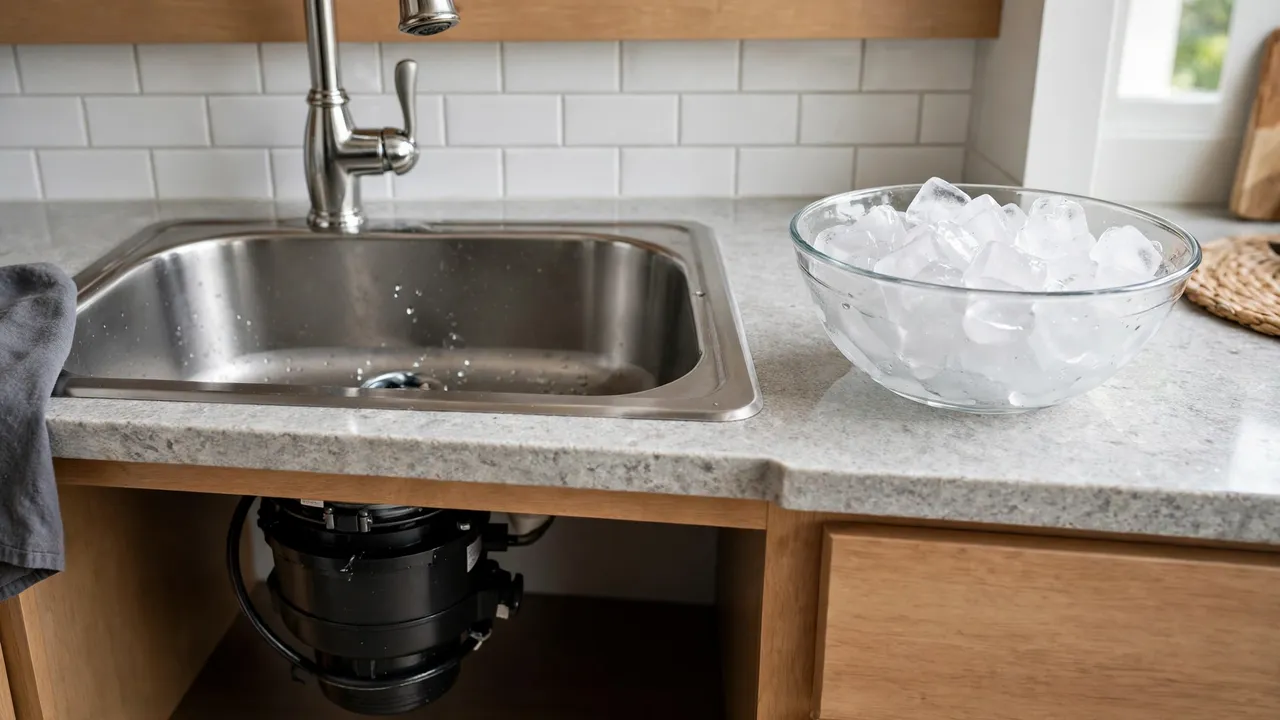
A garburator — the Canadian name for a garbage disposal — smells because food film builds up in three places water never reaches: the grind ring grooves, the chamber walls, and the underside of the rubber splash guard. The fix is mechanical first, chemical second: ice and coarse salt scrub the chamber, baking soda and vinegar deodorise it, and a toothbrush handles the splash guard, which is the number one smell source. About 15 minutes, power off whenever your hands or tools go near the opening, and never a hand inside the unit — tongs only.
What you need
- 2 cups of ice cubes
- ½ cup coarse salt (kosher or rock salt)
- ½ cup baking soda and 1 cup white vinegar
- Dish soap, an old toothbrush and a long-handled brush
- Tongs or pliers, a flashlight, rubber gloves
- 1 lemon or other citrus fruit, cut in wedges
Safety first
- Power off at the switch — and unplug under the sink or switch the breaker for any step where tools go near the drain opening.
- Hands never go in. Retrieve anything with tongs or pliers, always.
- No chemical drain cleaners and no bleach. They can corrode the unit and splash dangerously; never mix bleach with vinegar or ammonia.
Step by step
Step 1: Look inside and clear debris
Power off. Shine the flashlight into the chamber. If you can see anything that does not belong — a bottle cap, a fruit pit, a stray utensil — lift it out with tongs. This 30-second check finds the foreign objects that cause half of all "it stopped working" calls.
Step 2: Scrub the splash guard
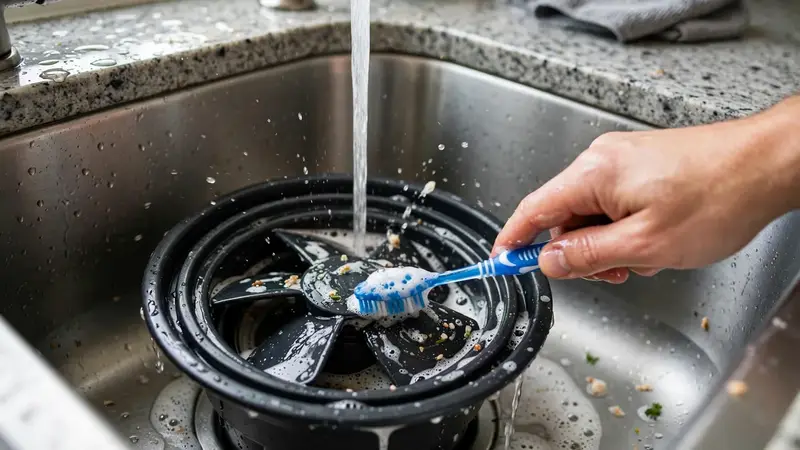
Lift the rubber flaps at the top of the drain and scrub the underside with dish soap and the toothbrush, working into every fold. Ground food lands on that underside every time the unit runs, no water flow reaches it, and it decomposes into dark slime in place — this is where most disposal smell actually lives. If the guard is removable, pull it out and wash it in the sink; a 10-minute soak in warm water with a spoonful of baking soda loosens thick buildup first.
Step 3: Ice and salt scour
Power back on for this step only. Pour the 2 cups of ice and the ½ cup of coarse salt into the drain, run a steady stream of cold water, and switch the unit on for 30–60 seconds, until the grinding sound settles. The ice shatters against the grind ring and impellers while the salt abrades the film off the chamber walls — a mechanical scrub that reaches where water cannot. (Freeze vinegar into cubes and you get the scrub and the acid in one step.)
Step 4: Baking soda and vinegar fizz
Power off. Pour in the ½ cup of baking soda, then slowly add the 1 cup of vinegar. It will fizz and foam up into the sink — that reaction loosens residue and neutralises odours. Leave it 10–15 minutes (a stopper over the drain keeps the fizz working down in the chamber), then flush with hot tap water for a minute, running the unit briefly at the end. Honest note: the fizz lifts grime and kills smell; it does not disinfect — the scrubbing steps do the real cleaning.
Step 5: The hot soapy flush (for grease)
If the smell has a greasy note, plug the drain, fill the basin halfway with hot water and a generous squirt of dish soap, then pull the plug and run the unit as the water drains through. The volume and the soap strip the grease film from the chamber and the discharge pipe below it — the spot a standard fizz never reaches.
Step 6: Citrus finish
Run cold water and feed the citrus wedges through, a piece at a time. The peel's oils leave the whole sink smelling fresh, and the rind gives the grind ring one last gentle scour.
Keep it clean: the habits that matter
- Always run cold water while grinding, and for 15–30 seconds after — cold keeps grease solid so it grinds and flushes instead of coating the walls.
- Run it regularly. A unit that sits for weeks rusts and smells; a quick spin every few days keeps it clear.
- Small amounts, fed slowly. Overloading packs food into the grooves you just cleaned.
- Never down the garburator: grease and cooking oil, coffee grounds, pasta and rice (they swell), potato peels in bulk, bones, and fibrous husks like corn and celery in large amounts.
- Monthly: repeat the ice-and-salt scour and the splash guard scrub — five minutes that prevent the deep clean entirely.
When the smell will not go
If a full clean does not fix it, the cause is usually below the unit: grease built up in the discharge pipe (the hot soapy flush, repeated), a rarely used dishwasher draining through the same line (run a cycle), or a worn splash guard that stays slimy no matter how it is scrubbed (they are cheap and replaceable). If the unit hums but will not spin, leaks from the bottom seal, or trips its reset repeatedly, that is a jam or a failing seal — a plumber's job, not a cleaning job.
More kitchen cleaning guides
Same room, same routine: how to clean a microwave and how to clean a toaster oven.
Frequently asked questions
What is a garburator?
Garburator is the Canadian term for an in-sink garbage disposal — the motorised unit under the sink that grinds food scraps so they wash down the drain. The cleaning method is identical whatever you call it: ice and salt to scrub, baking soda and vinegar to deodorise, and a toothbrush for the splash guard.
How do you get the smell out of a garbage disposal?
Work in order: scrub the underside of the rubber splash guard (the main source), scour the chamber with 2 cups of ice and ½ cup of coarse salt under cold running water, then pour in ½ cup of baking soda followed by 1 cup of vinegar, wait 10–15 minutes and flush with hot water. Finish by grinding citrus wedges.
How often should you clean a garburator?
A light clean — ice, salt and a splash guard scrub — once a month keeps odours away. Do the full routine, including the baking soda and vinegar fizz and the hot soapy flush, whenever a smell appears or every few months in a busy kitchen. Running the unit with cold water regularly does the daily maintenance for you.
Can you put bleach in a garbage disposal?
It is best avoided. Bleach can damage seals and splash back dangerously, and it must never be mixed with vinegar or ammonia. The ice, salt, baking soda and vinegar routine cleans and deodorises without it. If you want a sanitising step, wash a removable splash guard in hot soapy water instead.
Why does my disposal smell even after cleaning?
Usually grease coating the discharge pipe below the unit, which the fizz never reaches — repeat the hot soapy flush. Other causes: a worn, permanently slimy splash guard that needs replacing, food sitting in a connected dishwasher line, or buildup in the sink flange above the guard, which a brush and dish soap will reach.
Is it safe to put ice in a garbage disposal?
Yes — ice is one of the best things you can put in it. The cubes shatter against the grind ring and knock food film off the chamber walls, and the meltwater flushes it away. Add coarse salt for abrasion and run cold water while you grind. Ice does not sharpen the impellers (they are blunt by design), but it cleans them well.
Sources
Method cross-checked against published garbage disposal cleaning guides (splash guard priority, ice-and-salt scour, baking soda and vinegar fizz, hot soapy grease flush, cold-water habit, never-list). Written in our own words for A Natural Day readers.

Written by
MD DOLAR HOSEN
Technology expert and the founder and author of A Natural Day. He tests and reviews everyday tech, gadgets, and home essentials, and writes practical buying gui…



Comments (0)
Join the discussion — sign in to leave a comment.
Sign in to commentNo comments yet. Be the first to share your thoughts.